Tuesday, January 31, 2006

The Ten Comics That Changed My Life--Part 5

Walt Disney Comics Digest #7

Even without it, the memory of some comic books linger, even after they have been lost or thrown away. This is one of those for me. I wish I could show you the cover for this comic, but it is either rare or those people who have copies just haven’t gotten around to scanning it into a Website for my use. I know I saw this comic in Woolworth’s in downtown Milwaukee. Unless I looked it up, I couldn’t even tell you what the other stories were in the book, but there was one story included that introduced me to Carl Barks, “The Good Duck Artist.”

The story was Barks’s “Gyro Gearloose and Gus Goose on the Dream Planet.” Gus, Grandma Duck’s lazy farmhand, describes to Gyro the planet of his dreams where the denizens are all as lazy as he is and none the worse for it. Gus even points out where it is in the sky. Gyro, being an inventor, has a rocket capable of the flight; soon, he and Gus are on their way. Upon their arrival, Gus is delighted, and Gyro disheartened, by the laziness of the citizens—who are very goose-like in appearance—beings who refuse to make a minimum effort for anything. For instance, after Gus plops himself down under a tree to join in on the laziness, the person next to him says he is hungry. As luck would have it, an apple falls from the tree within an inch of the beings hand. Gus points out that he could reach out and pick up that apple. The response is that that would be too much work, soon enough, an apple will fall into his open hand.

Gyro, in a naïve effort to help progress along, picks up a fallen tree branch and uses it to shake an apple-bearing branch. So many apples fall that they carry Gus’s new buddy-in-lolling off and into a river. Though wet, he sees that the apples helped him do less work because he didn’t have to walk to the river (plus it allowed him to get a drink without having to wait for it to rain). First, apples are used for transport, but pumpkins as carriages quickly replace them and then gravity is replaced (movement was limited to just rolling downhill) as the new automobiles are powered by rubber band engines. As Gus watches his utopia slip away, he and Gyro see the telegraph, telephone, and rockets invented seemingly within moments of the original apple roll into the river. Worn out by just watching all the activity in the name of doing less, Gus tells Gyro it is time to go back to Grandma’s farm. Gyro agrees, taking the branch that started it all with him. As they head back, Gus takes the branch, leans it into the floor, and rests himself into its crook. On response to Gyro, Gus says that at least he can still dream of his dream planet.

I was around eight years old when I first read the story and probably beginning to truly understand differences in quality of a comic book based on just looking at the art. I mean, I was aware that Batman was drawn in Justice League was different from how he was drawn in his own comic, but until I read this story I never been viscerally affected by the differences. There were other stories in that digest featuring the Duck characters, but I just wasn’t as engaged by those as I had been by “Dream Planet.”

There were other Disney comics around the house, but now I only enjoyed the Duck stories by whoever (alone or in tandem) had written and drawn “Dream Planet,” the unknown “Good Duck Artist.” I was twelve or thirteen when I read The Comic-Book Book and learned that the writer/artist was Carl Barks. When I was eight, however, I didn’t need to know the name because it was the stories he created that mattered.

On a larger scale, I can mark this story as being the one where I started to be discriminating. Not that I wouldn’t have read every comic book printed if possible, but unless the art or story weren’t where I expected them to be, even at eight or nine, I was disappointed. For example, it appears that everyone else who was reading comics in 1969/1970 worships at the altar of Dennis O’Neil and Neal Adams, first for their work on Green Lantern, then for their post-Batmania Batman. I felt cheated when I read any of those comics because I thought the stories boring and had trouble following the art. At nine years old, I was an opinionated comic fan. Thank you, “Gyro Gearloose and Gus Goose on the Dream Planet,” for starting me along that path.

By the way, while I have grudgingly accepted O’Neil’s and Adams’s work with Batman, I’ve yet to find anything in their work with Green Lantern. Green Arrow gaining a beard and an attitude doesn’t make up for my nine-year-old self not getting to read more stories by John Broome and Gil Kane. But that’s just me.

Monday, January 30, 2006

One More Interruption

ToyFair 2006 opens in two weeks. We'll soon have hundreds pictures of the new toys (read: "those toys that are related to comic books, i.e. action figures") that should be released through this year and into the next.

The UK ToyFair was last week and there were three items that I thought to be interesting. (All images from Action-Figure.com, specifically starting from this page.)

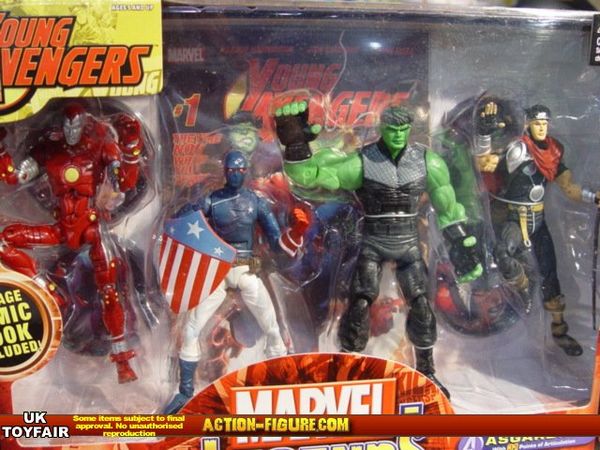
Marvel Legends Young Avengers Box Set
If you'd ask me to predict which team would be getting a box set, I would have predicted the Thunderbolts because of time in service, if nothing else or hoped for a Golden Age Marvel set featuring the Invaders and the Liberty Legion. That ToyBiz had the Young Avengers on display means that Marvel must understand that the word of mouth about Young Avengers has been better than the buzz for New Avengers.

Here's a picture of the figures in the packaging:


Here's a close-up, less the glare of the previous picture, that show off the characters better:

From left: Iron Lad, Patriot, Hulkling, and Asgardian

Marvel Legends Monsters Box Set
If you told me that ToyBiz was going to release a Champions box set, I'd have believed that before believing a Monsters set was on ToyBiz schedule (and then a Monsters set that didn't include a Man-Thing repaint, to boot). Here's the set:


Here are close-ups of the four figures:Clockwise from upper left: The Zombie, the Monster of Frankenstein, Werewolf by Night, Dracula.


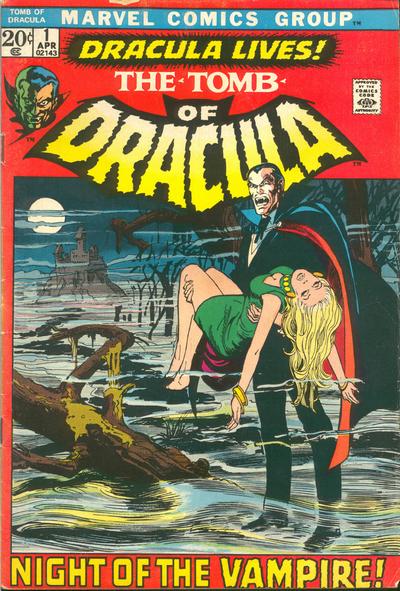
I know that there are going to be complaints that the Monster and Werewolf figures don't resemble Mike Ploog's art, and that the Dracula sculpt wasn't based on Gene Colan's work. I can understand those complaints. However, the Monster figure does look like it was based on Boris Vallejo's cover paintings from Marvel's old black & white magazine, Monsters Unleashed,


while the Dracula figure looks like it used the Neal Adams-drawn cover for Tomb of Dracula #1 for inspiration.


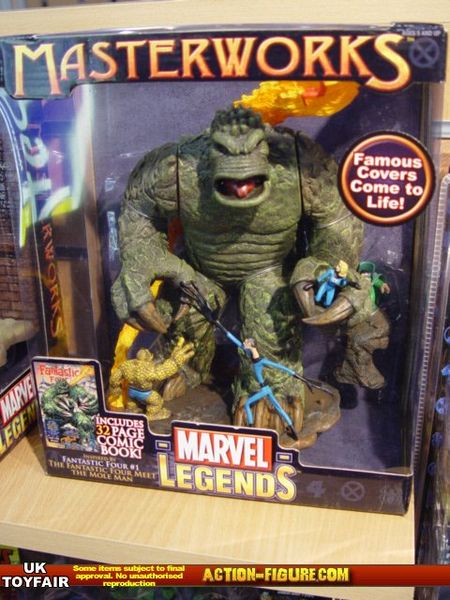
Marvel Legends Masterworks
I hate pre-posed action figures; they might as well be statutes. I hate the high cost of the statues that have come from DC and Marvel; I'd rather buy the unassembled, unpainted resin pieces and make the statue like a model. However, this set looks like it could be both a display piece and a toy that can be played with:
We really are living in a golden age of comic books and comic book-related merchandise.

Friday, January 27, 2006

Comics In My Future For March 2006 (conclusion)

Continuing with my March DCBS order:

Marvel
X-Statix Presents Dead Girl #3

Spider-Girl #96
Spider-Man Loves Mary Jane #4
The pessimist in me keeps me buying these comics. We don’t have any kids, but even if we have a child in the next year, I don’t have any assurance that comics will be printed in the traditional format within the next five, let alone that there will be any comics from the Big 2 that are child-safe or that would appeal to a little girl. I also read these and will miss Spider-Girl when issue #100, its last, comes out. I likeMary Jane too, and I admire it for basically being a teen drama with Spider-Man in a supporting role.

Apart for Squadron Supreme #1
I’m giving it a chance even though I’ve been caring less and less about this title as it petered to an end as a Max title. Unless something makes it stand out, this could be gone before the first arc is completed.

Captain America #16
Captain America 65th Anniversary Special
I’ll still lukewarm about Captain America (and I may be the only person who no great feeling about the title who wasn’t angry about “Winter Soldier”), but I’ll stay with it for a little while longer. Since Miller crushed the joy out of Daredevil and he can’t fill the role, I wouldn’t mind a Cap title that was just bounding with the energy it had forty years ago when it shared space with Iron Man in Tales of Suspense.

Fantastic Four #536
Someday, Karl Kesel will get the full-time writing gig on this title, but until then I’ll bide my time reading about child services trying to take the kids from Reed and Sue.

I (Heart) Marvel: Masked Intentions
I still don’t understand the point of these I • Marvel comics, but they look fun and the daughter who is just a twinkle in my eye, might like them.

Iron Man #6
Wow, a monthly Iron Man mini-series that will end before the one-year mark.

Marvel Team-Up #18
I think this isn’t selling better because the stories actually move along and that confuses people. Robert Kirkman has to start writing multiple talking-head scenes that fill up space and don’t move the story.

Marvel Adventure Spider-Man #13
Marvel Adventures Fantastic Four #10
If you read interviews with fans from that time, the Silver Age Marvel comics written by Stan Lee were then considered suitable for adults and daring. Now, stories told the exact same way are appropriate for children in a way current Marvel comics apparently are not. There are a couple of problems in that scenario that I think are part of the reason comic book circulation isn’t any better.


New Avengers #17
New Magnaverse #3
Nick Fury’s Howling Commandos #6
Pulse #14
I bash Bendis because I love and I don’t think I’ll be buying this any more after he leaves with this issue.

She-Hulk 2 #6
Thing #5
Thunderbolts #100
Young Avengers #11
Ultimate Extinction #11
I cannot believe I’ve stayed with this since the story began in Ultimate Secret five hundred years ago, but I’m stubborn that way.

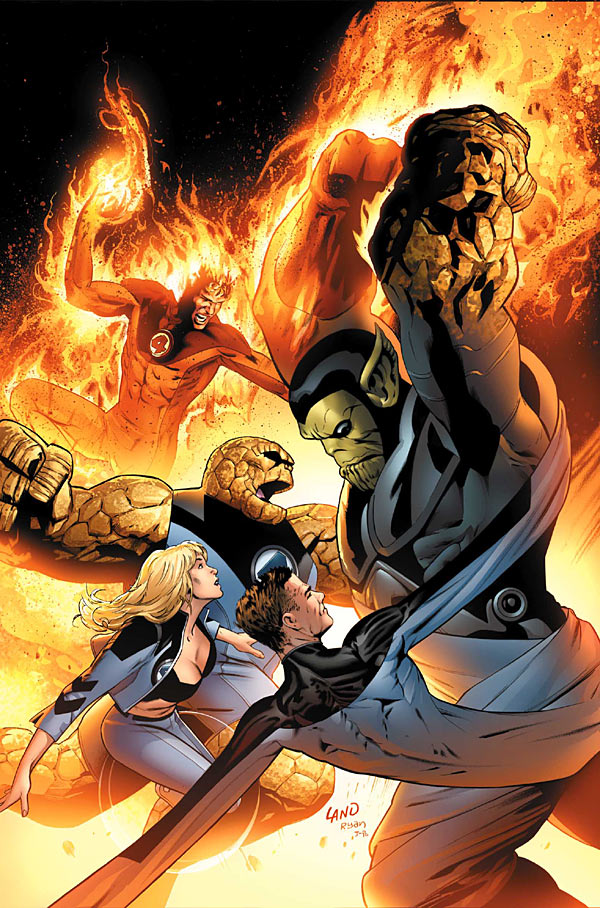
Ultimate Fantastic Four #28
I’m loving the stories and as individual pictures, I enjoy Greg Land’s art. However, can anyone honestly say with a straight face that the art is nothing more than a series of models posing? I’ve never been one to care one way or the other about how women are drawn in comic books, but even though Land understands anatomy better than other artists, he still shows the lack of common sense when it comes to clothing female characters poorer artists showed in the ninties. Look at the cover for this issue below.

If Reed Richards is the smartest man on earth, why the hell would he let his girlfriend go out to do battle with the Super Skrull in a halter and open jacket? You can’t even use the old “distraction” excuse because one would think that mammalian secondary sexual characteristics would mean nothing to a reptile. I don't care if she can create invisible force fields, even in a tank, you where your helmet.

Ultimate Spider-Man #s 91 and 92
I have a love/hate relationship with this comic. I find it very slow and it reads way too fast, but then every once in while something happens, like Peter dating Kitty Pryde, that makes it worthwhile. More than any other Spider-Man title, this is the one where Peter should tell his aunt about Spider-Man and it is frustrating that he doesn’t. Still, Bendis and Bagley, long ago, said they wanted to stay on this title as long as Lee and Kirby stayed on Fantastic Four, which means, barring something amazing, come #103, I’ll drop this title.

Powers #18
Still the comic that Bendis writes that I enjoy the most and the letters page never fails to make me laugh hard.

Marvel Masterworks Golden Age Marvel Comics, vol 2.
After playing a far second when it comes to reprinting its past, Marvel has come on strongly with its latest reprints of its Golden Age material. Unlike DC, Marvel took a chance and reprinted complete original comics, not just the stories of individual characters. Thank you, Marvel.

And The Rest
Alias
Victoria’s Secret Service #4
This comic is what I thought it was going to be—for some reason I thought it was going to focus on a group of female secret agents who worked for Queen Victoria—but the first few issues have been inoffensive, so I’ll at least finish the first story arc.

Bongo Comics
Simpsons Comics #116
Futurama Comics #24

Boom! Studios
Hero Squared Ongoing #1
I hope “Ongoing” is going to be an ongoing part of the title.

Gemstone Publishing
Donald Duck and Friends #338
Mickey Mouse and Friends #287
Uncle Scrooge #352
Walt Disney Comics & Stories #667

Heroic Publishing
Flare #33
Roy Thomas’ Anthem #2
Roy Thomas writing a comic set during World War II. I hope he’s done enough research on the era.

MR Comics
Big Max #1
If you can only buy one comic book featuring a super-powered gorilla, it might as well be the one written by Dan Slott.

Revolution on the Planet of the Apes #4

Speakeasy Comics
Black Coat: Call to Arms #1
What was the last comic book you bought that was set during the pre-American Revolution America?

TOKYOPOP
Kingdom Hearts, vol. 3

Comic related items
Action Figures
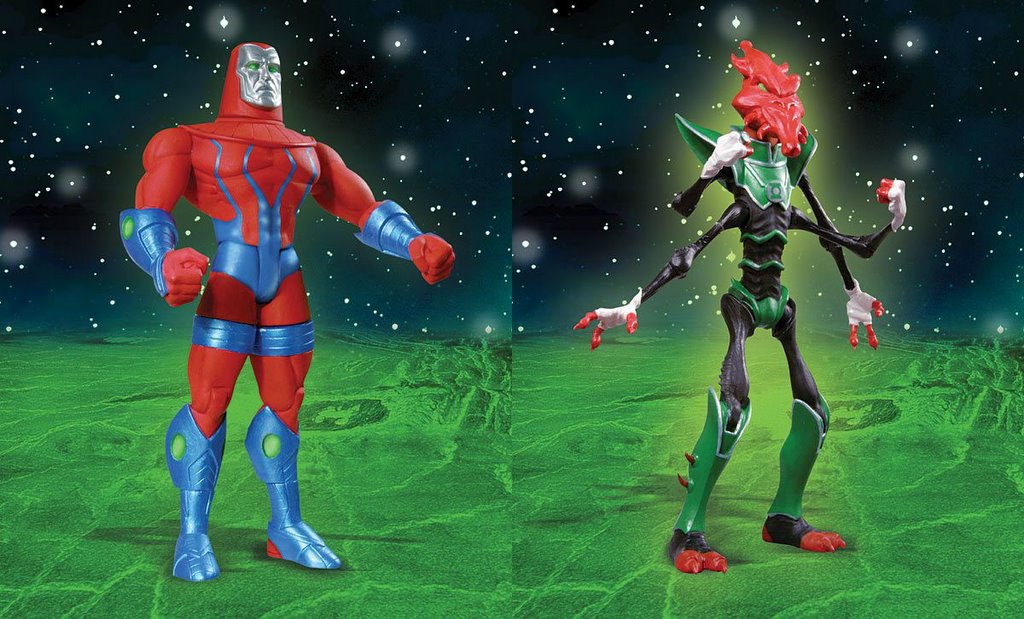
From DC Direct, the Manhunter Robot and Saalak Green Lanternaction figures

Magazines
Back Issue #15
TwoMorrows published this and Alter Ego are two of the best comic history magazines around. I’d order Alter Ego if I wasn’t already a subscriber.

Books
The Ultimates: Tomorrow Men

Here endth the March order.

Thursday, January 26, 2006

Comics In My Future for March 2006

I'm taking a break from comics that changed my life by inserting another series of posts. Because I get all my comics at the end of the month they are released, I don’t have the luxury of talking about them when they are released. However, with my January order due in to DCBS in a couple of days, I can at least discuss that in a timely manner. As of now, here’s the order that I'll be placing:

Dark Horse


A very slim month for Dark Horse from me, but most of their books don’t really interest me. I’d been buying the Little Lulu trades and enjoying them, but unemployment has forced me to make some choices, so Lulu was one of the titles that went.

Hellboy Makoma #2

DC


“One Year Later” starts with this month and I’m adding some titles. However, it isn't because I'm interested in how OYL has changed them, but rather because there are books I’ve wanted to read (or start reading again) but the creative teams weren’t doing anything to make the books appealing.

Batman #651
Detective Comics #817
Apart for Batman Strikes! I haven’t made an effort to buy an ongoing Bat-title in a long time; I just can’t respect the Batjerk DC has been allowing into print since the early nineties. However, with James Robinson writing both titles for three issues (and Paul Dini scheduled to take over Detective after Robinson) I guess I’ll be back, but carefully. The first time Batman treats a peer as a lesser, uses body blows as a substitute for detective work, or can’t see past the border of Gotham City, I’m dropping both titles.

Batman Annual #25
I’ll get it because I’m a sucker for annuals. In the eighties, the only time I ever bothered with some books was when I bought the annual. However, Judd Winick writing anything but his Barry Ween character scares me, because I know that all too soon, HIV will enter some character’s life and Winick will be on his soap box again.

All Star Superman #3
Take Frank Miller’s crapfest that is his version of Batman (apart from what he did in The Dark Knight Returns #2, divide it into the number one, and you have an idea of how much I enjoy this comic.

Superman #650
Action Comics #837
With Kurt Busiek and Geoff Johns, I have to think (hope) the stories will be more about Superman and less about Lois Lane’s bitchiness/randiness. However, I can only hope that Pete Woods’s art is a match since I’ve never seen it.

Supergirl #7
I have to admit that I haven’t liked Loeb’s writing on this book—in fact, I don’t think I’ve ever liked his writing—but I’m not sure Greg Rucka would have been my go-to guy here. My first choice would have been Gail Simone. I’m not crazy about Ian Churchill’s art, either. I’ll give this one a chance, but it’ll probably be among the first to go.

Superman/Batman #25
Thank you, Jebus! Jeph Loeb is finished writing this comic book and I hope he is taking “Lantern Jaw” Ed McGuinness with him. I don’t remember who is taking over the writing, but I hope whoever it is either does away with the internal dialog captions or has Superman and Batman admit their love. I really hate those captions.

Showcase Presents The Superman Family, vol. 1.
I bet I have at least half of the stories in this book in other reprint collections, but even at full price it is worth to read even one classic Jimmy Olsen story I don't own.

Superman Archives, vol. 7
Money is tight and I should pass this up, but the stories in this series have been getting better, so what the hell.

Infinite Crisis #6
I might as well see where this is heading; plus, I’m a sucker for the damn thing. If only the problems that were seething below the surface of the DCU hadn’t had to come to a head because of Identity Crisis.

Omac Project Identity Crisis Special
Aquaman Sword of Atlantis
Buying it for Busiek; I’ll see if I buy into the concept as a whole and stick around.


Birds of Prey #92
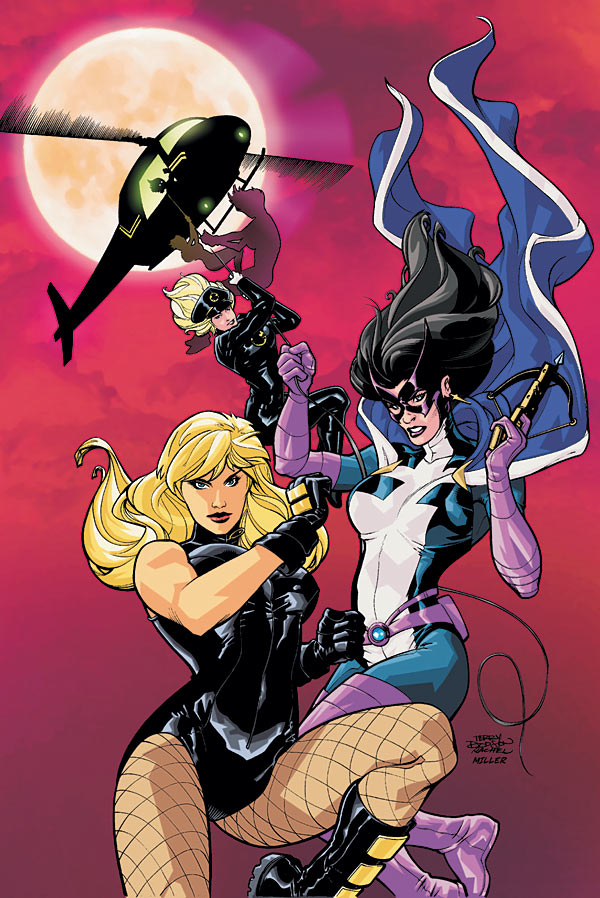
If only the Dodsons did more than the cover art for this comic.


Blood of the Demon #13
Green Lantern #10
Hawkgirl #50
I stopped buying Hawkman long ago, but the creative team of Walt Simonson and Howard Chaykin intrigues me enough to give the “OYL” version a try.

Manhunter #20
JLA Classified #s 18 & 19
JSA #83
Even if I wasn’t already pledged to buy this until the day I die, I’d have to buy it to see if Paul Levitz still has his writing chops.

JSA Classified #10
Supergirl and the Legion of Super-Heroes #16
A book I’ve been getting, but I have to admit that the “Supergirl” portion of the title has me excited just because it harkens back to the good old, pre-Crisis On Infinite Earths days of SuperBOY and the Legion of Super-Heroes

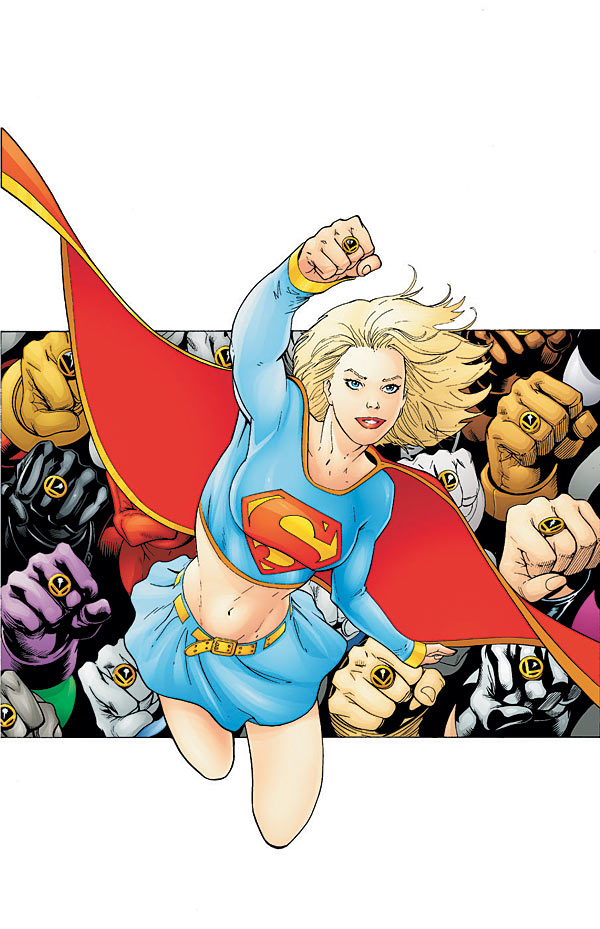
Even with Barry Kitson drawing it, I still don't like this version of Supergirl's costume.
Showcase Presents Teen Titans, vol. 1
Teen Titans #34
Seven Soldiers: Bulleteer #4
Seven Soldiers: Frankenstein #4
Seven Soldiers: Mr. Miracle #4
I have to admit Grant Morrison’s pulled Seven Soldiers off so far while staying coherent. I didn’t think he’d do it.

Spirit Archives, vol. 18
The American Way #2
Desolation Jones #6
Ex Machina #20
Fables #47
Y, the Last Man #43
The best news I read this week is that this series has a definite ending around issue #60. Good. I don’t hate it, but it is becoming boring and I would have considered dropping it. Actually, a new story begins in this issue; maybe I will drop it and wait for the trade, even if trade collections go against everything that is good and pure about comics.

The Batman Strikes #19
Teen Titans Go! #29
Cartoon Network’s canceling of this show was really dumb, but understandable. CN needs the time to show such classic cartoon features as Snow Day.

Justice League Unlimited #19
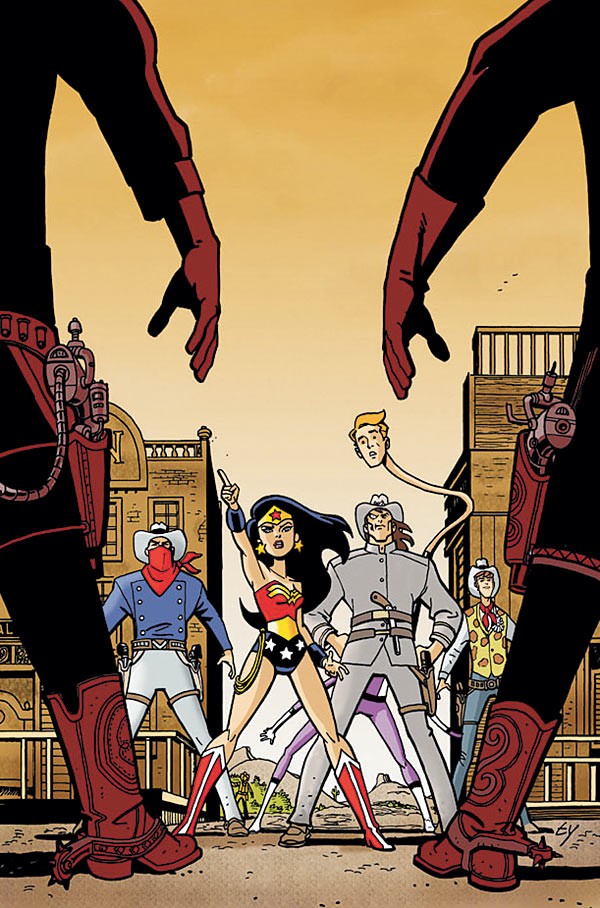
Would that the mainstream DCU be half as intriguing as this cover or half as fun as this comic book in general post-Infinite Crisis.


Image

Truth, Justin, and the American Way #1
Gun Fu trade paperback
I missed this the first time around and the description in Previews makes it sound like fun.

Retro Rocket #1
I’m a sucker for giant robots and clean art. Shoot me.


PVP #25
And I’m a sucker for comic books that are funny.

Fear Agent #6
Girls #11
You know, I didn’t like this comic’s first issue; I thought it was going to be another “relationship” comic like the brothers Lunas’Ultra had been. Boy, was I wrong. This is a creepy science fiction mystery that I really surprises me and I am looking to see where the characters will be when the story is told. ABC’s Invasion should be this good.

GØDLAND #9
I never thought I’d say this, but I am actually enjoying something Joe Casey is writing. I guess a hundred million miracles do happen every day.

The Intimidators #4
Savage Dragon #124

Tomorrow, the rest of the order.

Wednesday, January 25, 2006

The Ten Comics That Changed My Life--Part 4


4. Avengers Annual #2: “And Time, the Rushing River"

There are some comic books that once you see the cover, you have to have them; this is one of those for me. I’ll admit it, I’m a sucker for covers showing heroes battling heroes, especially in configurations like this where the then current Avengers battled the original Avengers.

I remember the day this one was bought for me. In downtown Milwaukee, there was exactly one traditional news stand by the mid-1960s, but what a newsstand. It had the shape of a large triangle. one side was all magazines, I don't think I looked there a total of ten times my whole life, while the other side was predominantly comic books with the assorted racing form (though Milwaukee didn't even have legalized horse racing) and Sporting News racked above and below them. The owner was a dwarf, who had at least one normal-sized sone that helped him run the stand, usually at night. My clearest memories of either of those two men is seeing one or both of the huddled in the doorway of Walgreen's, trying to keep warm in the winter or dry when it rained.

Making trips to that newsstand was one of the great joys of my life. There were stores in my neighborhood that sold comic books, but especially as I got older, I learned that if I wanted to make sure I got the next issue of a continued story, a trip to the news stand was required. In that respect, I appreciate the convenience of a comic book store, but I miss the newsstand. I miss the excitement of surprise the news stand offered, going there and not knowing which comics will have new issues or actually seeing a cover that makes you want to buy the comic. Even before the Internet, the surprise was going out of buying comic books because of the direct market. When you have to buy a catalog three months before the comics inside are released so that you can pre-order the comics you want, that pretty much takes away the mystery no matter how hard you try.

Apart from the cover, Avengers Special #2 makes the list because it was the first comic I can remember confusing me. I was seven when I got the comic and I could read, but those two things do not necessarily add to understanding. When this comic was published, I had at least a passing knowledge of some of Marvel's characters and continuity cobbled together from cartoons and other comics I'd looked at, so you'd think I’d be able to follow the story.

However, this is the first Roy Thomas-written story I can admit to reading and, let's face it, those who have read any amount of his mainstream super hero work knows continuity matters to him. What that meant is that a seven year old had dumped headfirst into a story that leaned heavily upon past events. Like Mighty Crusaders #4, this comic is chock full o’ heroes, villains, and plot. There’s time travel, parallel dimensions, and flashbacks to foreshadowed events. Even the Watcher shows up in the end to explain a Scarlet Centurion-Dr. Doom-Rama Tut connection I wouldn't have even known existed had Thomas not decided to tell me about.

Did I run from comic books after this one because of my confusion? Was I fearful of trying another Marvel comic for fear of feeling left out? Of course not, if for no other reason that there would have only been four comics that changed my life.

This comic showed me that there was a bigger picture to comic books than just the one I had created piecemeal from my relatively few sources; the world of Marvel comic books was bigger than just the comic was holding at any particular moment. Without understanding the concept, or what it would eventually mean to mainstream comic books within the next few years, I began to figure out that Marvel comic books required you to know inter- and intra-title continuity.

Armed with this knowledge, I began to seek out old comics whenever my parents went to rummage sales. I became the target audience for reprint comics, obtaining an oversized reprint book whenever I could talk my parents into paying a whole twenty-five cents for a new comic whichever parent I was with when I was bought Avengers Special #2 must have been in a particularly good mood. I wonder how my parents would react if I told them that there was a time I paid (pre-Internet) fifty dollars a shot for hardcover reprinting of comic books? I probably shouldn’t; they aren’t young and many was the time they would choke at the thought of paying a quarter.

Oh, and there was a strange parody story here, too, showing the behind-the-scenes machinations of the Bullpen as they put together the latest issue of Avengers, complete with pint-sized super-heroes running amuck. You know what, I still don't know what the hell is really going on in that story.

Tuesday, January 24, 2006

The Ten Comics That Changed My Life--Part 3


3. Mighty Crusaders #4: ”Too Many Super Heroes!”

By the time this comic book came out, the word was out that I loved the comic books. (Actually, with publishers dating comic books three months ahead of the month they are released, there is a very good chance that this comic, dated “April,” was actually released in January 1966, the month Batman premiered. With the word out, assorted relatives—well, probably just my mother and grandmother—started to buy them for me unbidden.

However, unless I was there, I had no assurance that I would be getting anything that I would actually want. I obtained many a Casper, Dennis the Menace, Hot Stuff, and Archie that way. Now, I admit that I looked at everything I was bought—and Istill have a fondness for Silver Age Casper and Hot Stuff—but given the choice, I would have chosen Doom Patrol over Casper's Ghostland any day.

Eventually, my family began to realize that it was super hero comic books that I really wanted. That resulted in an increase of Detective Comicsand Tales of Suspense coming into my possession. It also resulted in my seeing some less familiar super heroes like Gold Key’s Owl and Magnus.

(I’ll be honest and say that when I was a child I really disliked Gold Key comics that featured realistic humans, as opposed to cartoony humans like Elmer Fudd. I hated the covers, whether painted or, in the case of adaptations, repurposed publicity photos. I hated the stiff art and, when I learned how to read, I hated the stories because they felt pointless. I really only began to appreciate some of these comics within the last fifteen years beginning with Valiant’s reprinting Magnus, Robot Fighter and continues now with Dark Horse’s reprinting of Magnus , Doctor Solar, Man of the Atom, and M.A.R.S. Patrol Total War. If Dark Horse decides the market would support it, I’d like to see a reprinting of Space Family Robinson, which was Lost in Space long before the television series of that name was a twinkle in Irwin Allen’s eye. I still can’t bring myself to pick up the recent reprints of Gold Key’s Star Trek, though. This site provides the story of the relationship between the comic book and television series.)

As I was saying, I was beginning to see super heroes that didn’t come from Marvel or DC. It was during this time that I first looked at Mighty Crusaders #4; like the others, it was a comic that just appeared. I looked at it occasionally, but it never really sparked with me then. The comic languished in the comic book box, a big brown cardboard box in the closet where my brothers and I tossed the comics when we were told to put them away; I use proper comic boxes now, but still eschew the use of bags and boards.)

For anyone who hasn’t heard of this series or comic, Mighty Crusaders was published by Archie Comics under the guise of the Mighty Comics Group. During the Golden Age, MLJ Magazines—the company that would evolve into Archie Comics after the company realized which of their characters was buttering their bread—published straightforward super-hero comic books featuring the Shield, the Web, Hangman, the Comet, the Black Hood, and many others, but dropped them in favor of Archie and his friends by the end of World War II. In the late fifties, Joe Simon and Jack Kirby landed at Archie and produced two new comics, The Adventures of the Fly and The Double Life of Private Strong, the latter a reworking of the earlier Shield now in a Captain America mold.

By 1964, Jerry Siegel and Paul Reinman were working on the super hero line. In his writing, Siegel showed an amazing ability to predict trends as his stories were campy seven months before Batman was on television. He also, in what may have been an attempt to emulate the crossovers Stan Lee was doing at Marvel (in fact, a lot of the trappings of the Archie super-hero line at that time could be construed as having been crafted to copy Marvel), began reintroducing Archie’s Golden Age heroes. In his first issue (#31) of The Adventures of the Fly, now re-titled Fly-Man he brought back the Comet, the Black Hood, and what appeared to be the original Shield (he was actually his son). Those three, along with Fly-Man and Fly-Girl, formed a team, the Mighty Crusaders. After meeting for there for three more issues, the group was given its own title.

The story in Mighty Crusaders is incredibly simple, written by Siegel in his best “coincidence mode.” On the splash page, the Mighty Crusaders are gathering for a meeting, which is going to be broadcast on television, when an enemy attacks them. It is just the first of many such attacks from many different villains that were beaten back by the Crusaders and, my hand to God, every single super hero Archie published during the Golden Age. Alone and in pairs they arrived, for twenty-four pages, many choosing that day to come out of retirement, all of them demanding to join the Crusaders. In the end, none of them joined and the story ended as it began, with the Crusaders needing to hold their meeting.

In retrospect, I don’t know why I didn’t like this comic right away as it as everything I want to in a mainstream super-hero comic: action, soap opera melodrama disguised as character development, and the reintroduction of Golden Age super heroes. Thinking about the comic right now, I wish I had access to my copy so I could read it again, but at the time it did nothing for me. What changed my feeling toward the comic was that by the seventies I was reading books like All in Color For a Dime that introduced me to comic book history. Where else but Mighty Crusaders #4 could I actually see a clear picture of characters like Steel Sterling, Roy, the Mighty Boy, and Bob Phantom?

In that context, “Too Many Super Heroes!” retroactively became my “The Flash of Two Worlds”: It gave me access to “forgotten” characters in a way like no other comic I owned. I know that this comic is the one that helped foster my interest in the history of comic books and for “forgotten” characters, those characters published no longer or sporadically. To this very day, I am still a sucker for every character revival, JLA/JSA team-up, or reprint that comes down the pike and I know a great part of that is due to Mighty Crusaders #4; quite a feat for a comic I didn’t really have any opinion one way or the other when I first read it.

Monday, January 23, 2006

The Ten Comics That Changed My Life--Part 2


2. Superman #193

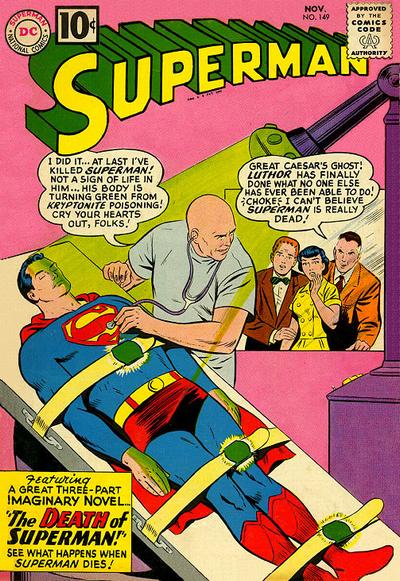
There were other stories in this issue, but only one has stayed with me since 1967 is the original, classic “The Death of Superman.” (A quick check of The Greatest Superman Stories Ever Told shows that this story was originally presented in Superman #149, 1961.) I was six when I came across this book and I was probably at exactly the right age to fall under the spell of the writing style editor Mort Weisinger championed among his writers. I know that every CHOKE!, GASP! and zee . . . zee . . . zee make post-modern comic fans wince with embarrassment. Personally, I think that such shorthand helps convey a story to those who are “age challenged” and helps keep a story in a manageable package, as opposed to, oh, let’s say, a two-part story stretched into a four-part arc, just the right size for a trade paperback reprinting.

Superman #193 (above) reprinted "The Death of Superman," which was originally printed in Superman #149 (left).
(Images from Grand Comcs Book Database
.)


Fittingly, Superman co-creator, Jerry Siegel, wrote the story. To a comic fan that started reading comic within the last eighteen years or so, I’m sure the story is terribly presented and incredibly hokey; the story doesn’t progress because of character motivation as much as a series of events occur. A Superman story from the Weisinger era often feels as though they were written to the tempo of The Saber Dance. I can even almost see Weisinger standing behind his desk, snapping his fingers as he gives each order ala James Cagney in One, Two, Three, telling Siegel to move on.

Beyond that, however, this was the first comic book story to affect me. I mean really get to me. I knew Superman wasn’t dead, if only because there were other Superman stories in the comic book, but I was still able to understand how important it would have been had Superman really died.

The story draws you in slowly. Maybe Luthor really does want to reform. He cured cancer, for goodness sake, and later he stood up to criminals threatening him with death if he didn’t play ball. Maybe only a child, or Superman, could actually believe that someone so evil could really reform. Then comes Luthor’s betrayal and Superman’s slow death at his hand by kryptonite poisoning, Luthor turning the screw by forcing the hero’s dearest friends to watch.

The third chapter is where I completely bought into the story as we are shown the world mourning Superman. The opening mini-splash alone convinced of how important this story was because not only was Batman in line to pay his respects as Superman lie in state, but Aquaman, Flash, Green Arrow and Wonder Woman where there, too. Batman was known to be Superman’s friend, they were in a comic book together, so for other heroes to show up underlined the importance of the event.

(I know that even as a young pre-reader, it was never a problem that aliens would invade Flash’s home city, for instance, yet Superman never showed up to help out. Maybe because I was learning about comic books on my own, I easily was able to keep each character in his or her little comic world. Flash stories were over there and Green Lantern stories over there and Justice League adventures in a third place and there was no intersection--or as we call it now, "continuity"--unless it was necessary. Like in “The Death of Superman.”)

In counterpoint, Luthor was celebrating with the underworld cronies, gangsters and molls from this side of The Adventures of Superman. As Luthor gloated and lovingly retold the tale of his triumph to his admirers, a statue and a painting depicting Superman’s final moments, loom behind him. He had killed Superman and, subconsciously, I was becoming aware of how potent a medium “comic books” could be, if you were willing to let yourself believe in the story.

Then, magnificently, Superman returns! He crashes through a wall, rubble flying, surprising the gathered criminals! Of course, he’s alive; Superman can’t die!

In the second panel, Superman ends Luthor’s celebration as the criminal scientist’s compatriots turn on him verbally. Then, in the next panel, we see that it isn’t Superman, but Supergirl in disguise, revealing her existence to the world by capturing her cousin’s murderer.

Supergirl flies Luthor off to Kandor, the Kryptonian city shrunken and preserved by Brianiac before, now safe in Superman’s Fortress of Solitude. Luthor will answer for his crime before a tribunal of Superman’s fellow survivors as the world watches. More knowing, I can now see the parallel between Luthor’s trial and the post-World War II war crime trials.

Throughout this story, the art of Curt Swan, with George Klein inking, has been wonderful, as always. Others may favor Swan teamed with Murphy Anderson, or Joe Shuster, or Wayne Boring, but to me the perfect Superman art team was Swan and Klein. Looking at Luthor as he stands trial, you can see the muscles in Luthor’s face radiating his arrogance, the contempt he feels for the Kandorians palatable.

His contempt grows from his belief that he is still in control of the situation, that no sentient being is truly honorable. In exchange for his release, Luthor offers to enlarge Kandor again, something Superman had promised to do for his fellow Kryptonians. To his surprise, the tribunal rejects the offer and Luthor is sentenced to death, one more humane than what he caused Superman to suffer.

The story ends with Supergirl and Krypto (“Now I belong to . . . Supergirl,” the dog thinks) patrolling the skies, taking up Superman’s never-ending battle. In the final panel, a ghostly, heroic shade of Superman waves his down upon the two from the heavens (or Heaven), wishing them well.

How in the world could a kid not want to keep on reading comic books after a roller coaster ride like that? They don’t write them like that anymore; they probably don’t dare. I don’t know how kindly the comic fan of today would take to an imaginary story breaking up the “flow” of continuity. I think that fans cheat themselves out of some great stories because they want every issue of every continuing series they buy to be a required piece of continuity. Not that imaginary stories aren’t being written anymore, but they are usually presented as expensively packaged mini-series that don’t sell as well as they could.

This story showed me that the basic underlying theme of any, what we would today call “mainstream,” super hero story should be hope. Superman died, but his killer was captured and punished. Maybe more importantly, Superman’s legacy continued. For a young child, the world is black and white and I think it should be for as long as possible. Shades of grey will come soon enough, sometimes it seems sooner than it had for the previous generation. Had I been six years old and the story I’d read been ambiguous story (or just one part of a year-long event), I can’t say that I would have wanted to read other Superman comic books.

This story stays with me, who age and experience have pushed toward pessimism, still if only because it is unashamedly optimistic, allowing for hope in the most dire circumstances. And I’m secure enough to say that I like that outcome still.